

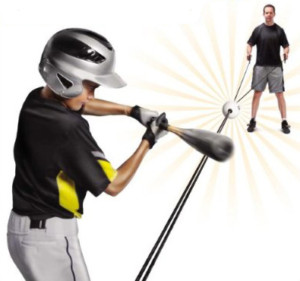
The ZipnHit PRO Youth Baseball Trainer is available at Baseball2u.com at a discount price.
Infield Drills For Softball and Baseball Players - Get the Outs Your Team Needs!
By Dennis McCurley
Some old expressions just get better with time. To be any good at almost any sport you must "keep your eye on the ball". This is especially true when it comes to playing an infield position on any softball or baseball team. To fully live up to this statement you must practice, practice, and practice some more.
Someone once said that practice makes prefect. I totally disagree. However, prefect practice will make one prefect. Playing any of the infield positions on a baseball diamond requires many skills and some talent. To improve at the skill level one must participate in the drills of practice.
The first drill that most coaches and players work on is simply ground balls. Here it is important for the fielder to ensure that he/she is in front of the ball as it approaches. In youth ball it is recommended that the player actually go down on his/her left knee for right handed, opposite for left handed, and field the ball. The reason for going down on one knee to make sure the glove is on the ground so the ball will go under the glove and into the outfield. It is easier for a young player to drop to one knee than it is to lower the butt to allow the glove to be on the ground.
After all players have fielded several ground balls now it is time to begin situational drills. No body is on base, the ball is hit on the ground to third, the third baseman scopes up the ball and throws to first. This drill is repeated until all infielders, including the catcher, fields several ground balls hit to his/her area and successfully throws to first.
Now then the situation changes. Here you have a runner on first so the intent is to make sure you prevent this runner from advancing to second. So, wherever the ball is hit the first throw is made to second base. If the ball is hit to the left side of the infield then the second baseman covers the bag. If the ball is hit to the right side of the infield then the shortstop covers second. After several of these situational plays have been made it is time to step it up just a bit.
Once again you have a runner on first with less than two outs. Now you will still be concerned with preventing the runner from advancing to second but also want to attempt to throw out the batter at first base. This is call a double- play and is very important in the games of baseball and even softball.
If the ball is hit to third base, the infielder fields the ball, he is to throw to second base which will be covered by the second baseman. Here it is very important for the third baseman to make sure he steps directly towards second. If his step is more towards left center then the ball will tail in that direction and pull the second baseman off of the bag therefore preventing the first out of the double-play. If his step is more towards right cent or even right field then the ball will tail in that direction causing the second baseman to be pulled into the base path and possibly causing a collision between the fielder and the runner. Even if the second baseman is able to apply the tag the umpire might rule runner interference and award the base to the runner. This is why it is imperative for the third baseman to work on his footwork so that he/she will be able to make a true throw to begin the double-play.
Assuming that the third baseman delivered the ball to the second baseman without pulling the player in any direction it is now time for the second part of the double-play. If the second baseman was at the bag when he/she caught the ball all that needs to be done is the bag needs to be touch by either shoe, a step backwards is taken, then step and throw to first. This is the ideal way in which to turn a double-play. If the second baseman receives the ball as he/she is approaching the bag then the base must be touched and since the forward progress will take the player towards third the fielder would then jump in the air, twist his/her body around in the direction of first base, and then attempt the throw. I am sure that you can easily see why being at the base before the throw is the best way to complete this type of double play.
Now then if the ball is hit to the shortstop a simple relay toss needs to be made to the second baseman. Here it is important to make sure that the shortstop does not throw the ball in the same manner as if he was throwing to first base. While a quick throw is important, throwing the ball too hard for such a short throw will probably end up with the ball being missed or dropped by the second baseman. Again it is best for the second baseman to be at the bag awaiting the throw so he/she can then pivot and make the throw to first.
If the ball is hit to second the fielder must set his/her feet to make a clean toss or throw to the shortstop so that the throw to first can be made quickly and accurately. If the second baseman fields the ball as he/she is headed towards second then a simple underhand should suffice. If the fielder is moving towards first then the fielder will have to set his/her feet to enable an accurate throw to second which normally will be a sidearm throw.
Now then, if the ball is hit to the first baseman he/she will need to make sure that the lead foot is inline towards second base so the shortstop can then relay the ball back to first. The same manner as the third baseman the footwork must be correct. Again if the lead foot is more towards left field the ball will tail in that direction and if the foot is more towards center field the ball will tail that way. After making the throw the first baseman must then turn and return to first so that the relay throw from the shortstop will have a chance of completing the double-play.
After these situations have been covered and fully explained it is now time to work on the pop-up. Here it is important for the fielder to position themselves under the pop fly. They should make the catch with both hands to assure that the ball will not be able to spin out of their glove. If games will be played during the day then each fielder will need to practice shielding the sun from their eyes by using their glove to block the sun. This is not as easy as it appears but with practice the skill is obtainable.
By working on these drills one can only hope that the learned skills will equate into the outs that are needed to be reached in every game. Remember, practice does not make one prefect;however, prefect practice does enable one to be prefect.
Article Source: http://EzineArticles.com/?expert=Dennis_McCurley
Article Source: http://EzineArticles.com/5999412
============
Thanks to Our Sponsor – Baseball2u.com
BatAction Youth Hitting Machine
BatAction 360
SKLZ Lightning Bolt Pitching Machine
SKLZ Light Bolt PRO Pitching Machine
Joe Mauer PX4 QuickSwing Baseball Trainer
Advanced Skills Tee by Muhl Tech
SKLZ 5 Position Batting Tee
ZipnHit Pro Baseball Swing Trainer
Jugs Small Ball Pitching Machine
