Youth Baseball Coaching Clinic Official Blog

Welcome to the official blog of the Youth Baseball Coaching Clinic. Our blog features free youth baseball articles and daily posts on every aspect of coaching youth baseball including youth baseball practice organization, youth baseball practice drills for youth baseball, youth baseball coaching tips and baseball strategy for coaching kids. Make sure to save this site to your favorites. You will want to visit our site regularly because we update daily. Good Luck to You and Your Team!


Showing posts with label baseball batting drills. Show all posts

Thursday, July 22, 2010

How to Improve Batting Average and Get Full Contact When Hitting a Baseball


How to Improve Batting Average and Get Full Contact When Hitting a Baseball
By Guest Author Joe Brockoff

Young or old, new to the game or not, no one likes to strike out. So, when I see players struggling with making contact while at bat I simply ask, "How do you feel at the plate?" Most often, the response is the same, "Coach, I'm not seeing the ball."

My response? Use your imagination. Throughout my career in baseball, I've developed hitting drills that convert complex techniques into easy-to-learn applications using imagery. My system is practically fool proof, requiring only a player's willingness to imagine and a desire to succeed.

So how can we use imagery to help batters "see the ball?"

The Problem: "I can't see the ball."

We hear players say it all the time, especially after striking out. Following the ball from pitch to plate is a serious challenge for many hitters, yet we know that the ability to read the pitch and make proper judgment is as important as anything in becoming an efficient hitter. This also decreases rushing and increases confidence.

The Super 8 Hitting System Solution: "Visualize the Target"

Let's imagine that the ball is a target. If we want to hit the bull's eye on a target, then it is necessary to aim for the bull's eye. If the outer ring will give us 10 points, and the bull's eye will give us 100 points, what part do we focus on? The bull's eye, of course. It gives us the highest reward.

With this in mind, let's do a few "making connections" hitting drills, using either regular batting practice or a pitching machine.

Drill #1: Loose Body, Full Take

1. Stand in the batter's box. Take a deep breath.

2. Stand tall with a soft body, soft in the hinge joints.

3. As ball is pitched, keep eyes horizontal, placing a quarter-size imaginary red dot in center of ball.

4. Read pitch all the way to catcher, using just the swivel of the head. Move nothing else.

5. Repeat several times.

Drill #2: Stride-Take

1. Begin as in Drill #1.

2. As ball is pitched, load and stride, reading pitch back to catcher.

3. Continue to visualize bull's eye.

4. Important: Do not move hands from starting position.

5. In the stride, front heel remains up, with 30-40% weight now on front side.

6. Hips remain closed.

7. Repeat several times.

Drill #3: Drive-Take, Add the Pivot

1. Begin as in the first two drills.

2. Pivot hips at completion of stride.

3. Important: Hands rotate with body; they do not commit to the pitch.

4. Hitter is now taking pitch in "drive position."

5. Visualize where "cut" or cut line on the ball will be.

6. Read ball to "contact zone" in front of plate.

7. Repeat several times.

Drill #4: Take and Stroke

1. Batter reads pitch in loose body.

2. Visualize the proper cut line and take pitch.

3. Take several full swings, use same cut line.

4. Each time, visualize a positive hit.

5. Repeat several times.

Through repetition, these visualization drills will dramatically improve a batter's hand action. The batter will no longer swing to contact, but snap at the point of contact, yielding a remarkable and measurable improvement in speed and contact-ability.

Hi. I'm Coach Joe Brockoff, a Division I Head Baseball Coach for Tulane University for more than 19 years, and former minor league player for the New York Yankees. Over the years, I've taught thousands of baseball players how to increase batting speed and improve their overall performance on the field. In fact, my proven training system has sent 45 baseball players to the pros.

As a coach committed to continuous improvement, I share my baseball drills, tips, and techniques here so that you will, in turn, inspire and motivate young players to improve their game. I hope you'll visit my web site, the Super 8 Baseball Hitting System at http://www.learnbaseballhitting.com/super-8-hitting-system.html?gclid=CIKf96-17qICFUsJ2godDWdXaw to watch some of my free instructional videos.

Learn more about the Visualizing the Target baseball hitting drill and other proven methods for improving batting speed by visiting my Super 8 Hitting System - http://www.learnbaseballhitting.com/ bestselling baseball training web site and instructional video package, which includes many free youth baseball drills and tips.

Article Source: http://EzineArticles.com/?expert=Joe_Brockoff

======================

=======================================
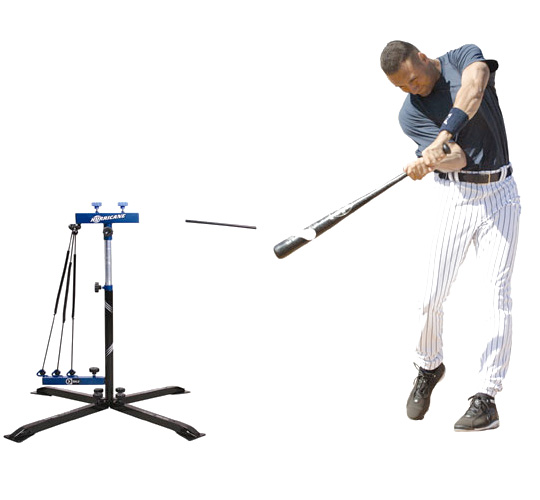
Derek Jeter Hurricane Hitting Machine
=======================================

Derek Jeter Hurricane Machine Training Blog

HurricaneMachine.com - Links

---15 Reasons To Buy a Hurricane Trainer
---6 Questions Often Asked By Customers
---Message to Parents From Coach Nick
---Hurricane Hitting Machine Drills
---20-Minute Hurricane Batting Practice Workout
---Hurricane Hitting Machine Video Demo Clips

Baseball2u.com has a one of the internet's largest selections of baseball coaching and training dvds

Wednesday, July 14, 2010

Free Baseball Batting Drill - Batting Trainer


Drill: “Step-In-And-Hit” Baseball Batting Drill

Helps correct the “Stepping Out” hitting flaw.

Objective: This drill emphasizes “stepping into” the ball to generate power and bat speed. This is an excellent drill to help young hitters eliminate the bad habit of “stepping out” during the swing.

Procedure: The batter starts the drill by standing farther away from the machine than normal. This starting position allows the batter to take two steps inward before swinging the bat.

The batter will step first with the back foot and then with the front foot. When the front foot “lands” the batter attacks the ball.

The drill may be performed with a still or moving ball. The batter should take the time to set and observe all body movement before and after each swing. It is sometimes good to have the batter freeze after the swing to see if the proper finish position is reached after each swing.

The batter should make sure to make contact with the ball component and not the shaft.

Recommended Number of Swings: 10 Swings

Coaching Point: The “Step-In-And-Hit” drill is a drill that every coach and parent should be familiar with and know about. At young levels of play we often see a batter “step-out”. The batter may have a fear of being hit. This drill works great in helping break this bad habit.

Coaching Point: If you observe a batter that is popping the ball up or missing the ball completely, chances are good that the batter is “flying open” or “losing the front-side” during the swing. The batter should use a closed stance and make a special effort to keep the toes, knees, belly button, and shoulders square to the plate until contact is made with the ball.

Coaching Point: If you observe a batter that is hitting everything into the dirt with a weak ground ball, chances are good that the batter is attacking the ball too soon. The batter should never have to reach or move the back foot to make contact with the ball. The batter should allow the ball to “come-inside” the batters front foot before attacking the ball to insure that proper contact can be made. This attack timing allows the batter to use the front legs as leverage to generate maximum power. The bat makes contact with the ball on a level plane rather than after the bat starts “arching upward”. This level contact allows the batter to hit line drives.


http://www.HurricaneMachine.com

Tuesday, May 11, 2010

Five Drills to Do When Hitters Pull Their Head


Five Drills to Do When Hitters Pull Their Head
By Jack Perconte

One of the most common hitting problems involves hitters taking their eye off the ball before making contact. Solving this problem is rarely as simple as just telling a hitter to "Keep your eye on the ball" or saying, "See the ball hit the bat." Usually, hitters pull their head and subsequently their eyes off the ball because of an incorrect hip turn or having a long arm swing, failing to use their hands and forearms.

Having said that, there are some good hitting drills that baseball coaches can have their players do that will help ballplayers keep their eye on the ball. Also, by controlling their head throughout the swing, it will help all the other hitting fundamentals, which is an added bonus of these drills.

Head Control Drills that will help hitters keep their eyes on the ball:

1. During batting practice, place an object to the opposite side of home plate from where the hitter stands and a few feet in front of home plate. This object (player's glove, pop can, etc...) should be in line with hitter's eyes at contact with the ball. The object of drill is to have batters keep their eyes on this object after contact is made and until the completion of their swing.

2. Along the same lines and when performing tee, flips or dropped ball drills have the coach, who is standing off to the side, flash a number down with his fingers immediately after contact. The hitter is required to read the number before looking for the hit ball.

3. Behind the hitter flips are great for keeping a hitters head in on the ball. The coach kneels a safe distance behind the hitter where the catcher usually is and the coach flips balls forward into the hitting zone. Hitters watch the ball being released from the coach's hand and swings when the ball reaches the hitting zone. With this ball coming from behind, it will force the hitter to keep their head and eyes on the ball.

4. Writing a decent size number on a few baseballs during batting practice and having hitters try to read the numbers when hitting is also a good drill. This can be extremely challenging, of course, but will make the point of how well hitter's need to watch the ball.

5. It is important to realize that balance comes from the hitter's head. Practicing hitting on a balance beam or similar balancing object, can greatly help hitters keep their eye on the ball, as well as helping all swing fundamentals.

Finally, a habit that I use to incorporate in major league baseball was to watch the ball all the way to the catcher's glove on pitches that I did not swing at. Baseball coaches should teach young hitters to do that also. It will help them keep their eye on the ball when they do swing as well, which is the obvious goal.

Former major league baseball player, Jack Perconte gives baseball hitting tips and batting practice advice for ballplayers of all ages. His baseball playing lessons, books and advice can be found at http://www.baseballhittinglessons.com/baseball
Jack is the author of two books, The Making of a Hitter and Raising an Athlete - his positive parenting advice and books can be found at http://positiveparentinginsports.com

Article Source: http://EzineArticles.com/?expert=Jack_Perconte

Hurricane Video


HurricaneMachine.com - Links

---15 Reasons To Buy a Hurricane Trainer
---6 Questions Often Asked By Customers
---Message to Parents From Coach Nick
---Hurricane Hitting Machine Drills
---20-Minute Hurricane Batting Practice Workout
---Hurricane Hitting Machine Video Demo Clips

Baseball2u.com has a one of the internet's largest selections of baseball coaching and training dvds.

Thursday, May 6, 2010

The Perfect Baseball Hitting Drill?


Heater Pitching Machines at Baseball2u.com
The Perfect Baseball Hitting Drill?
By Jack Perconte

The sign of a good baseball hitting drill is one that forces the correct hitting fundamentals and that over time, causes the correct hitting action when a hitter goes without the drill. With that in mind, some drills are obviously better than others. The drill below does just that. It forces of the correct action and works on all the important hitting fundamentals of staying back, compact swing, weight shift, hips opening and follow through.

Because this drill combines all the correct baseball hitting fundamentals into one drill, it makes teaching hitting easier and quicker, as long as it is performed correctly. It is a little complicated and requires some hitting tools that one does not usually have in the basement, or backyard. The local batting cages though will have the things needed - balls, protective screen, batting cage.

Here is the perfect baseball hitting drill:

1. The hitter stands very close (within six to 10 inches) from a net, facing the pitcher with the net being behind the hitter where the catcher stands. The hitters rear foot and hands should both be this distance away from rear net. Make sure a home plate is set and hitters stand their normal distance from the plate.

2. The coach sets up behind a protective screen with a bucket of balls in front of the hitter, beginning at twelve to fifteen feet away.

3. The coach flips balls to the outer half of the plate - firm underhand flips are best from this distance, trying to keep the ball level with no rise or drop on the flipped ball.

Result you are looking for? Because the ball is on the outer half of the plate, hitters should drive the ball to the opposite field by missing the net on the initial portion of the swing but hitting the net on the follow through.

Note: Hitters may graze the net on way forward and come up a little short of hitting net on follow through and this is acceptable.

Why is this the perfect baseball hitting drill?

1. One of the main fundamentals of hitting is "staying back" - if the hitter jumps forward (lunges or over strides) they will not be able to hit the net on the follow through.

2. Another goal of hitters is to have a compact swing - when a hitter's swing is long, in anyway (upper cutting, casting, dropping barrel behind them) they will be striking the net on the initial portion of their swing.

3. Another objective of a good swing is to have the hands in a power position (palm-up, palm down) at contact. By hitting the ball to the opposite field on this outside pitch, this drill will guarantee that the hitter is in this correct contact position.

4. Another component of the perfect baseball swing is that the hitters' weight transfers while their hips open - missing the net on the way forward will promote weight shift and the only way to hit the net on the follow through, or get close to it, is to open the hips.

5. Another ingredient of good hitting is that hitters' keep their eye on the ball; thus, the reason for working on the outside pitch. It is further recommended that hitters keep their eyes in the direction of where they ball is hit, while trying to hit the net on the follow through as hard as possible.

As hitters begin to perform the drill with some consistency (frequent line drives with back-spin to the opposite field), the coach can begin to back up until eventually doing the drill from regulation, hitting distance.

Is the drill the perfect hitting drill? Maybe not, but if done correctly, it works on all the necessary hitting fundamentals all at once. Finally, I am sure that I have not been the first one to discover this drill, but it is one of my favorites while teaching hitting over the last twenty-two years.

Former major league baseball player, Jack Perconte gives baseball hitting tips and batting practice advice for ballplayers of all ages. His baseball playing lessons, books and advice can be found at http://www.baseballhittinglessons.com/baseball
Jack is the author of two books, The Making of a Hitter and Raising an Athlete - his positive parenting advice and books can be found at http://positiveparentinginsports.com

Article Source: http://EzineArticles.com/?expert=Jack_Perconte

Our Sponsors:

===Advertisement from our sponsor:=====
Baseball2u.com/CoachesBest.com is the ultimate online baseball training and coaching store. With over 1400 products organized into categories Baseball2u.com makes finding that baseball training product easy and simple. Order securely online or by phone. Baseball2u.com is a fully licensed company and has a full time staff available from 8:00 to 5:00 CST. Their toll free customer service number is 1-877-431-4487.

The Categories they have are: BatAction Hitting Machines, Hurricane Hitting Machines, Batting Cages, Pitching Machines, Jugs Equipment, Game and Practice Baseballs, Protective Practice Screens and Nets, Portable Pitching Mounds, Baseball DVDs & Books, Clearance Items on Sales, NEDCO Bataction Replacement Parts, Baseball Training Equipment, Youth Baseball Training Equipment, Training Bats, Pitching & Throwing Trainers, Defensive Trainers, SKLZ Hurricane Replacement Parts and Much Much More! Visit Baseball2U.com today!

Friday, April 30, 2010

Youth Baseball Hitting - How to Fix Your Baseball Swing


Youth Baseball Hitting - How to Fix Your Baseball Swing
By Brian McClure

To hit the ball well takes a lot of practice. Youth baseball is actually easier than for older players because there is only the basics to learn and develop. This makes it easy for as as coaches to improve our youth baseball teams hitting.

We still must do it right. Practice does not always make perfect. The practice must be effective and done correctly or the mind and body will instill the wrong mechanics.

Hitting off the tee - has probably been a lost art. It is however making a comeback in certain circles. I have always started batting practice by hitting off the tee. Yes..all ages. Purpose of the tee is to load the bat and get our weight back. First check that the players hands are in the right place..batting stance should comfortable. Second, Load the bat (Body and hands go slightly back and front foot comes up) Third, short quick swing.

Common mistakes to look for and avoid is the player dropping his hands and and weight back to far which is caused by wrapping the hands around the head. Wrapping the bat and Dropping the hands is usually the youth baseball player trying to hit a hard fly ball. It lengthens the swing and there will difficulty in hitting the ball correctly(popups) if at all, in live pitching.

Soft Toss - My favorite way to practice hitting. A youth baseball coach (or whoever is doing the tossing) can get a lot of control over the ball and watch the mechanics without fear of injury. The most common way I see soft toss done is from the side of the batter. I prefer to use a screen and toss from the front. This better simulates the pitch and the tosser and see the hands, head, and stride better too. Franklin L-Frame Pitching Screen
Work on strike tosses in the middle, inside, and outside... up, down. Toss in a few balls too so the player can work on learning the strike zone also. As you see a lot of work can be done in a short period of time.
If you toss from the side ,it is best to have net to target the balls.

Free Hitting - Turn 'em loose. Pitch or use a pitching machine and let the youth baseball player work on improving his hitting with live pitches without a lot of coaching at this point. Let the player have fun and just hit away. The Tee drill and soft toss is to work on mechanics. Now Focus on the ball and Swing.

These tips and basic batting practice strategy will greatly help your players improve their hitting skills. As a parent you can quickly move your son to the meat of the batting order with these simple batting practice two or three times a week. As coaches we should try and implement some batting practice every practice. The best way is to divide them into groups..some work on tee..move to ..the soft toss..then free hitting and move on to shagging.

Author- Brian McClure Want to learn more about helping your child in youth baseball as a parent or coach? http://www.coaching-youth-baseball.com

See our complete list of Topics and articles on youth baseball here http://www.coaching-youth-baseball.com/topics.html

Article Source: http://EzineArticles.com/?expert=Brian_McClure

Sponsor Links:

===Advertisement from our sponsor:=====
Baseball2u.com/CoachesBest.com is the ultimate online baseball training and coaching store. With over 1400 products organized into categories Baseball2u.com makes finding that baseball training product easy and simple. Order securely online or by phone. Baseball2u.com is a fully licensed company and has a full time staff available from 8:00 to 5:00 CST. Their toll free customer service number is 1-877-431-4487.

The Categories they have are: BatAction Hitting Machines, Hurricane Hitting Machines, Batting Cages, Pitching Machines, Jugs Equipment, Game and Practice Baseballs, Protective Practice Screens and Nets, Portable Pitching Mounds, Baseball DVDs & Books, Clearance Items on Sales, NEDCO Bataction Replacement Parts, Baseball Training Equipment, Youth Baseball Training Equipment, Training Bats, Pitching & Throwing Trainers, Defensive Trainers, SKLZ Hurricane Replacement Parts and Much Much More! Visit Baseball2U.com today!

'''''''''''''''''''''''''''''''''''''''

Check us out on Twitter:

Blog4Coaches

Monday, March 1, 2010

Top 5 Baseball Drills to Improve Your Baseball Game .


www.QuickSwingTrainer.com

Article Title: Top 5 Baseball Drills to Improve Your Baseball Game
By Kendra L Fagan

Open professional baseball tryouts are designed to help scouts determine the physical talents and abilities of aspiring baseball players.

Though many of the drills that young MLB hopefuls are put through might seem random. This is because different drills are put to people to test their skills level. While one person trying out might have a killer pitch and he knows it, a scout might want to see what the person's skill level is with other types of baseball maneuvers.

Scouts look for speed, arm strength, glove skills, and hitting skills and overall mechanics. The tryouts are grueling and not like any version of American Idol you've seen. There is no "nice" judge. Instead, baseball scouts simply call out the names of those they like. The rest of the players go home, and many of theme eventually give up on their dream.

But not unlike any talent-based industry, hearing "no" is just part of the game. It is up to you and your trainers to make sure you are getting all the necessary drills and skill-building exercise to take you to your goal of becoming a professional baseball player.

I have compiled some of the best drills for cross-skill development that will give you a leg up in the competition and hopefully win you the interest of a baseball scout.

AROUND THE WORLD DRILL

The "Around the World" drill is a great conditioning exercise that will help any baseball player develop physically.

Here's how it works.

Take the players to the foul pole in left or right field. Then time them from foul pole to foul pole to get a good accurate base time. Then have a set time that they should complete each of the laps. Some choose seven laps, some others. The number should be based on the number of innings one would play professionally. A good hint is that coaches should remember to adhere to is to not let a lap count if it is under time. This will help the player push himself to get it right. There is no "almosts" in pro baseball.

DIVE BACKS

Besides basic conditioning, this drill helps to build the players speed and quickness back to the bag. Also, it is helpful to work on quickly leaving the bag as well as helping the players to recognize how big of a turn they can make around a bag to make sure that they get back in case of a throw. Here's how a good Dive Backs drill is set up.

The players start out at Home Plate and run around first base, making an aggressive turn, and then dive back into the bag. After diving back they get up as fast as they can and head to second base to do the same thing. They do this also at third then slide feet first into home plate to end their round.

A good way to prove the get back theory is to have an outfielder and a second basemen trying to get a player out every couple of times through. This exercise works wonders for agility and speed skills which is an absolute necessity to play in the major leagues.

THE GLOVE BASEBALL DRILL

Conditioning is a grueling task, so some fun elements need to be used as well. A good fun conditioning drill is great because you can make them the hardest and the fun elements makes it not so bad.

The glove drills starts off with separating players in groups of 4 or 5. (If you are just with yourself and your coach, find a friend or two to help.) Line the people up and put their gloves in the outfield at about 25 foot intervals apart, away from them. They start the drill with a ball in their hand and run to the first glove and set the ball on it and come back to the line and go back and get the ball and come back to the line and go to the second glove and set the ball down and go back to the line and so on and so forth, until all the players have gone through and the winners get out of laps at the end of the practice.

SPEED QUICKNESS AND POWER

In any good baseball training program, player development is a primary concern. As players get older they also raise their level of function in the game. One of the areas to try to improve is the physical or talent area. If you are at all seriously about playing professionally you must first be in the talent pool of players. If you can't do the physical levels, no one will look at the skill or playing abilities.

A well rounded pre-season conditioning program starts when the players get back from Christmas break. Work should be focused on 3 areas essential to playing baseball at a professionally competitive level - speed, quickness, and power.

The first day should be spent testing the components of each skills set that are vital to an overall skill matching assessment. Test items can include:

· 40 yard sprint
· 10 yard sprint
· Standing 2 footed vertical jump
· 30 second dips
· 30 second sit-ups
· Home to 1b
· Bench press
· Dot jumps
· Diamond push ups

After the testing is done, you should have a good two months dedicated to a program that incorporates exercises, running, and strength training. Once this part is done, practice the test points listed above again. This will help you accurately measure your progress and where to improve.

THE 60 YARD DASH DRILL

This is used to determine sheer sprint speed, and it is chosen to determine the athlete's ability to run from the length of two bases. If you decide to incorporate this for your child, do so sparingly and make sure that your child is warmed up. Also reduce the length from 60 yards to only twice the distance from home to first. Of course, make sure that your child is medically approved to do sprinting. Keep the number of such dashes very low and GRADUALLY build up over time.

Here is a good pointer:

When asked to hit, scouts do not look at the end result of whether the ball was a hit, home run, foul ball, etc. Instead, they look at mechanics in order to determine if there is a "loop" in a batter's swing, weight transfer, and the batter's overall approach to the plate appearance. If you are able to introduce your child to one of the scouts during a break at the tryout, ask the scout to give you a minute to understand what he likes to see in his ideal batter. You may learn quite a bit.

Baseball Pros Store has excellent online deals on baseball equipment, strength training books, and off-season training guides to help you get into the major leagues in no time! BaseballProsStore.com baseball shop is your one stop shop for baseball bats, gloves, and training equipment. Plus items are updated everyday so you don't have to waste time driving from sports store to sports store. Begin your dream of playing professional baseball and visit http://www.BaseballProsStore.com today!

Article Source: http://EzineArticles.com/?expert=Kendra_L_Fagan

Sponsor Links:


www.QuickSwingTrainer.com

Monday, February 15, 2010

How to Develop a Compact Baseball Swing


Derek Jeter Hurricane Hitting Machine by SKLZ

How to Develop a Compact Baseball Swing
By Jack Perconte

All major league hitters have compact swings. They could not get to that level without one. What separates hitters at this level is their degree of bat quickness and bat speed. Bat quickness determines how quick they can get the bat to the ball once they decide to swing. This is one of the ingredients needed for being able to wait on the pitch as long as possible and for making contact. Bat speed determines the amount of power that a hitter will produce if solid contact is made when the ball is hit. Once again though, all major league hitters have compact baseball swings. This is vital in order to hit the speeds that major league players face.

You might ask, "If they all have compact swings, why do some strike out so much?" There are three reasons for that and one was mentioned, bat quickness. A compact swing does not guarantee a quick bat. Two, some players put more tilt in their upper body with their swing. When players collapse their back side creating un-level hips, they create more up-swing, leading to greater lift on the ball, but more misses too. Three, some players simply have better hand-eye coordination.

Developing a compact swing should be the goal of young baseball hitters too. This will be necessary if they wish to consistently hit as they move up the baseball ladder.

First, a definition of a compact swing is necessary. Compactness implies a short, tight area and this would define a good baseball swing. A compact baseball swing is one in which the bat barrel goes from hitting position (above hitter's rear shoulder) directly to the ball as the hands descend into a palm-up, palm-down position approaching the strike zone. The bat barrel stays relatively close to the hitter's head on the way to the ball, without taking a detour to the contact area. Why is this so necessary? The more compact the swings, the longer hitters can wait on the ball which is a huge advantage when making decisions on different speed pitches.

Following are the drills that will lead to a compact baseball swing, giving ballplayers the best chance of having baseball hitting success:

1. Place a pad under the hitters lead arm and take some swings without the pad falling out till the follow through. Hitters will develop strong quick hands and forearms with this drill and not a long arm swing.

2. Have hitters stand belly button away from a net and take swings with the edge of bat just grazing the net with a full, fast turn. This will force hitters to keep the hands close to body to avoid casting the bat.

3. Have hitter stand with net close behind them (toward catcher) and take swings missing net on way toward ball. This drill is best done with no stride and will not allow hitters to drop the bat barrel

4. Set a batting tee hip high and even height with hitter's rear hip. Hitters take swings while missing the tee and hitting balls at any level, even knee high - best done with dropped ball drill or soft toss flipped balls.

5. Dropped ball drill - coach holds ball up in air and drops ball into the hitter's strike zone after the hitter takes their stride. A compact swing is necessary to make solid, consistent contact.

6. Alternate fast and slow pitches until hitters learn to have the same quick swing on all pitches - when players make good contact on both speeds while hitting balls in the direction of where the pitch is located is the goal.

Finally, hitters can perform a few of these drills in combination with the other drills to challenge them further. For example, combining the glove under lead arm (# 1) and the dropped ball drill (#5) with the tee hip high(#4) at the same time can be done.

Former major league baseball player, Jack Perconte gives baseball hitting tips and batting practice advice for ballplayers of all ages. His baseball lessons, books and advice can be found at http://www.baseballhittinglessons.com/baseball.
Jack is the author of two books, The Making of a Hitter and Raising an Athlete - his parenting blog and books can be found at http://positiveparentinginsports.com

Article Source: http://EzineArticles.com/?expert=Jack_Perconte

======================
Sponsor Links:

=======================================
Derek Jeter Hurricane Hitting Machine
=======================================

HurricaneMachine.com - Links

---15 Reasons To Buy a Hurricane Trainer
---6 Questions Often Asked By Customers
---Message to Parents From Coach Nick
---Hurricane Hitting Machine Drills
---20-Minute Hurricane Batting Practice Workout
---Hurricane Hitting Machine Video Demo Clips

Baseball2u.com has a one of the internet's largest selections of baseball coaching and training dvds.

Wednesday, January 13, 2010

Baseball Hitting Tips

Hurricane Baseball Batting Machine


Here are some of the many questions:
How long should it be?
What direction should it go?
Would it be best to eliminate it?


One thing is for sure: The stride, done poorly, will often do more harm than good. Here are some of those issues: Over-striding, stepping the bucket, and not getting the foot down in time.


One might think, let's just eliminate the stride. Or let's just put the front foot out, with only a little weight, and keep the rest of the weight back.
In all of our years of studying baseball hitting tips for research and development of the Super 8 Hitting System, we looked for answers to those questions.


I am a hitting purest, meaning that if the activity is not necessary, then we don't do it. In other words, economy of action, doing only the absolutes with no wasted motion is the way to go. So should we eliminate the stride? Many coaches teach this in their clinics and camps using many baseball hitting drills.


My belief is that while no stride is ten times better than a bad stride, a good stride is better than no stride. Against a good velocity pitcher, a hitter must have quick hips. He must be able to turn quickly, clearing his hips and getting his hands out in front for contact. The stride is an asset for this. It provides a continuation from linear to rotation for the fast ball and for transfer of weight through the ball.
Here is the timing factor:


Fast Ball: Stride - Stroke Off Speed: Stride - Pause - Stroke


Think of the top that young people used to play with. With all of the electronic games of today, the old "top" has been sort of put away on the proverbial shelf. But the top used to be a favorite toy for youngsters. It's a rounded object with a pin on the bottom. They would wind the string around it, toss it forward holding onto the end of the string.


When the pin of the top hit the ground, the top would change from linear direction to rotational. It would spin, and spin until it lost its momentum and flopped over.


If the top were merely dropped straight down vertically, this would create a very loose rotation, if any, and it would almost immediately drop over on its side.


So what's the point? Like the linear action of the top gives it the force that it needs for strong rotation, so does the linear action of the stride provide a good rotation of the hips toward the ball.


Former Tulane Hall of Fame Baseball Coach, Joe Brockhoff, fully explains his baseball hitting drills with the Super 8 Hitting System, completely demonstrated with videos and hitting tips to help you hit with more power and raise your batting average. http://www.learnbaseballhitting.com/.
Article Source: http://ezinearticles.com/?expert=Joe_Brockhoff


=======================================
Derek Jeter Hurricane Hitting Machine
=======================================

HurricaneMachine.com - Links

---15 Reasons To Buy a Hurricane Trainer
---6 Questions Often Asked By Customers
---Message to Parents From Coach Nick
---Hurricane Hitting Machine Drills
---20-Minute Hurricane Batting Practice Workout
---Hurricane Hitting Machine Video Demo Clips

Baseball2u.com has a one of the internet's largest selections of baseball coaching and training dvds.

Sunday, January 10, 2010

Baseball Coaching Digest - The Swing Looks Perfect But the Batter Always Hits a Weak Ground Ball


By Nick Dixon

We have all seen this scenario. The batter has above average bat speed, above average hitting skill and is always extremely aggressive at the plate, but is simply not getting on base. The swing looks great but weak or poor contact is made. The batter is in a serious hitting slump. The only pitch the batter seems able to hit hard is the fast ball on the inner part of the plate. It seems like every other ball he makes contact with is a ground ball weakly hit back to the pitcher. And when it hits it hard, it is a "worm-burner" back to the pitcher. This article offers reasons and corrections for this hitting flaw.

What causes this hitting flaw?

The answer to this question is one word, "timing". The batter is not being patience enough. The batter is attacking the baseball too quick or too soon. The bat is not making good solid contact with the baseball because the bat is already through the POWER ZONE before the ball gets there. When the batter attacks the pitch too soon, the bat has passed through the "level plane" and has started to move upward when it contacts the ball.

Many young batters and overly aggressive or impatience older batters, want to attack the ball as soon as possible. They often attack it too it early before the ball reaches the plate. No matter how hard the swing is, the batter is only making contact with the top edge or third of the baseball. This contact at the very top of the ball is forcing the ball hard downward off the bat, thus creating a "hard worm burner" back to the pitcher.

How is this batting flaw be corrected?

You may have heard a coach in the past say, "Let the Ball Get In". What this means is that the batter should let the ball get inside the front foot. The only pitch a batter should attack before it gets inside the front foot is the fast ball on the inner third of the plate. Every other pitch must be allowed to get inside the foot before the batter attacks it.

Letting the ball get in allows the bat to make contact when the bat is on a level plane. The best way to correct the flaw is to do a front toss drill and making sure that the batter waits until the ball gets inside the front foot before attacking it. Patience and timing are the two important things batters must learn to use at the plate. Having these two traits are the key to hitting line drives for base hits.

I hope that you found this article to be useful and informative. You may find other articles like it at the Baseball Coaching Digest and the Youth Baseball Digest. I thank you for taking the time to read it. Have a great day. Nick


The CoachesBest Baseball Store has a great selection of 1400 Baseball Products. Check out the BatAction Hitting Machine baseball pitching simulator. This high speed training machine is 100% Guaranteed to raise Batting Averages and has a full year warranty.

Nick Dixon is the President and founder of Nedco Sports, a sports training company established in 1999. Dixon is also an active and full time high school baseball coach with over 25 years experience. Coach Dixon is better known as the inventor of the BatAction Hitting Machine, the SKLZ Derek Jeter Hurricane Hitting Machine, the SKLZ Target Trainer, the SKLZ Derek Jeter ZipnHit Pro, and the SKLZ Strikeback Trainer. Dixon is also a contributing writer for BaseballCoachingDigest, the Youth Baseball Digest, the Baseball Parent Guide, the Baseball 2Day Coaches Journal, and Blog4Coaches.

Article Source: http://EzineArticles.com/?expert=Nick_Dixon

===Advertisement from our sponsor:=====

Baseball2u.com/CoachesBest.com is the ultimate online baseball training and coaching store. With over 1400 products organized into categories Baseball2u.com makes finding that baseball training product easy and simple. Order securely online or by phone. Baseball2u.com is a fully licensed company and has a full time staff available from 8:00 to 5:00 CST. Their toll free customer service number is 1-877-431-4487.

The Categories they have are: Baseball Training Equipment, Youth Baseball Training Equipment, Training Bats, Pitching & Throwing Trainers, Defensive Trainers, Batting Cages, Pitching Machines, Jugs Equipment, Game and Practice Baseballs, Protective Practice Screens and Nets, Portable Pitching Mounds, Baseball DVDs & Books, Clearance Items on Sales, BatAction Hitting Machines, Hurricane Hitting Machines, NEDCO Bataction Replacement Parts, SKLZ Hurricane Replacement Parts and Much Much More! Visit Baseball2U.com today!

Wednesday, December 9, 2009

Three Baseball Batting Drills - Streak Drill, Switch Hitting Drill and Step-In and Hit Drill

Video shows three great baseball hitting drills being done on the Bat Action Hitting Machine. The BatAction baseball batting trainer's high speed ball movement and large ball path closely simulates real pitching conditions. The BatAction is often called the "Backyard Basketball Goal" for baseball players because it makes home batting practice easy, fun, challenging, and convenient. The BatAction Hitting Machine has height and speed adjustments for all ages and skill levels.